
THE FINE LINE | with Dawn Huckelbridge
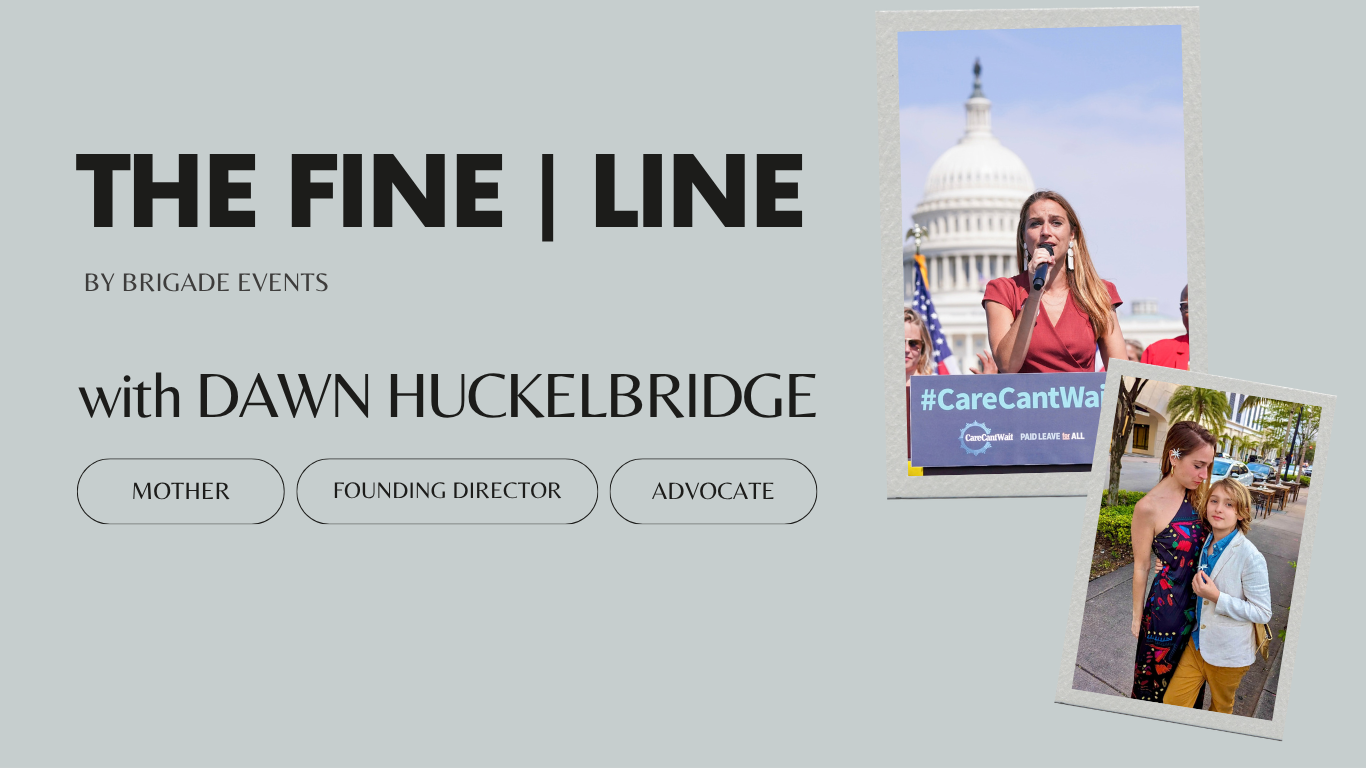
The Fine Line | DAWN HUCKELBRIDGE
Dawn Huckelbridge has spent her career asking a deceptively simple question: What would it look like to build a country that actually accounts for care?
As the founding director of Paid Leave for All, she leads the national campaign for paid family and medical leave in the United States, bringing a career spanning gender equity, political organizing, and communications to an issue that touches nearly every stage of life. At the center of her work is the belief that care isn't a private problem for families to solve on their own, but a fundamental part of how we live and work.
For this edition of The Fine Line, Dawn reflects on motherhood, ambition, and the systems that shape both — why care belongs in our definition of a functioning workplace, what becoming a mother changed about the future she wants to help build, and why creating better support for families ultimately benefits everyone.
You spent years working in gender policy AND ADVOCACY before becoming a mother. What did you know about the challenges facing American families that took on a different meaning once you experienced them yourself?
Even knowing so many of the stats and facts — our lack of paid leave and affordable child care, our lack of investment in women’s health — I didn’t realize how brutal this country is to mothers until I lived it.
I didn’t realize what a crisis it is until I felt like I was in my own crisis:
I knew the United States didn’t have a national paid leave policy, and I knew the low rates in the private sector, but I had no idea what it felt like to walk out the door weeks postpartum, still in pain, wearing heels, carrying a pump, and hearing my newborn screaming for me.
I had no idea how hard breastfeeding could be, especially without good professional support, or how sick mastitis could make a person.
I was afraid of not sleeping enough, but I’d never experienced a colicky baby or gone to work after weeks without any sleep at all.
I knew a lot of horrible data points about maternal health, but I still couldn’t believe the way I was treated in the hospital while I was giving birth or in the hours after.
I had no idea how long it would take to heal physically or how little follow-up there was.
When you are part of the statistics in real time, even with a good deal of privilege, you understand it viscerally. We often say that paid leave is not a workplace perk; it is a lifeline. I kept thinking, if it’s this hard for me, how do so many people get by, or survive?
And the truth is, many of them do not.
What did becoming a mother teach you about ambition? Did it diminish it, sharpen it, or simply change what you were willing to sacrifice for it?
I don’t think becoming a mother dulled my ambition, but I think most of us would agree there are seasons to our lives.
I was also lucky that I had a wildly supportive family — parents who could come help when I had a work trip, a partner who would walk our baby at 4 AM so that I got an hour of sleep sometimes, or who would lay on the floor for weeks to try to sleep train him when I said I was desperate. I was determined not to lose opportunities, or for my work to suffer, but there was no way I could have done it without that support.
The workplace didn’t feel kind to new motherhood in my experience. It was treated like an inconvenience, a flaw, something to be penalized for. And it all took a toll on me personally. But, I moved on.
Now, part of my ambition is making my son proud. My colicky baby grew into the most delightful young man. My ambition is to raise a good boy and to leave a better world for him — and to give other mothers and families a different experience.
Paid leave is often discussed as a women’s issue, but caregiving touches nearly everyone eventually. Has framing care as women’s work actually made it harder for us to build systems that work for everyone?
Women (and women of color in particular) are disproportionately impacted by a lack of paid leave, and historically have done more caregiving. I think it’s important to acknowledge that, but I do think it does us a disservice to only focus on it.
Because yes, every one of us will need to give and receive care in our lives — and it’s increasingly reaching gender parity.
For instance, in states with paid leave programs, dads have been taking paid parental leave at the same rates as moms (even exceeding in some cases). But also, every one of us will get sick. Anyone can get injured. We all have aging parents.
Also, it won’t shock you to know that issues disproportionately impacting women have often been sidelined politically. Emphasizing what a universal, economic, kitchen table issue this is is key to its success — and its success will in turn contribute to a more equitable country and political system.
FOLLOW ALONG
Follow Dawn’s journey on her Instagram, and explore how you can support Paid Leave For All.
Follow Brigade Events and stay tuned for the next iteration of The Fine Line at @brigadeevents.
We’d be honored to include you — or a woman you admire — in this series. If you or someone you know has a story to share, we’d love to hear from you. Reach out to us at carly@ingoodcompanypr.com. Together, we can uplift, support, and redefine leadership for the next generation.
#TheFineLine #WomenWhoLead #BrigadeEvents