
THE FINE LINE | with Lauren Smith Brody
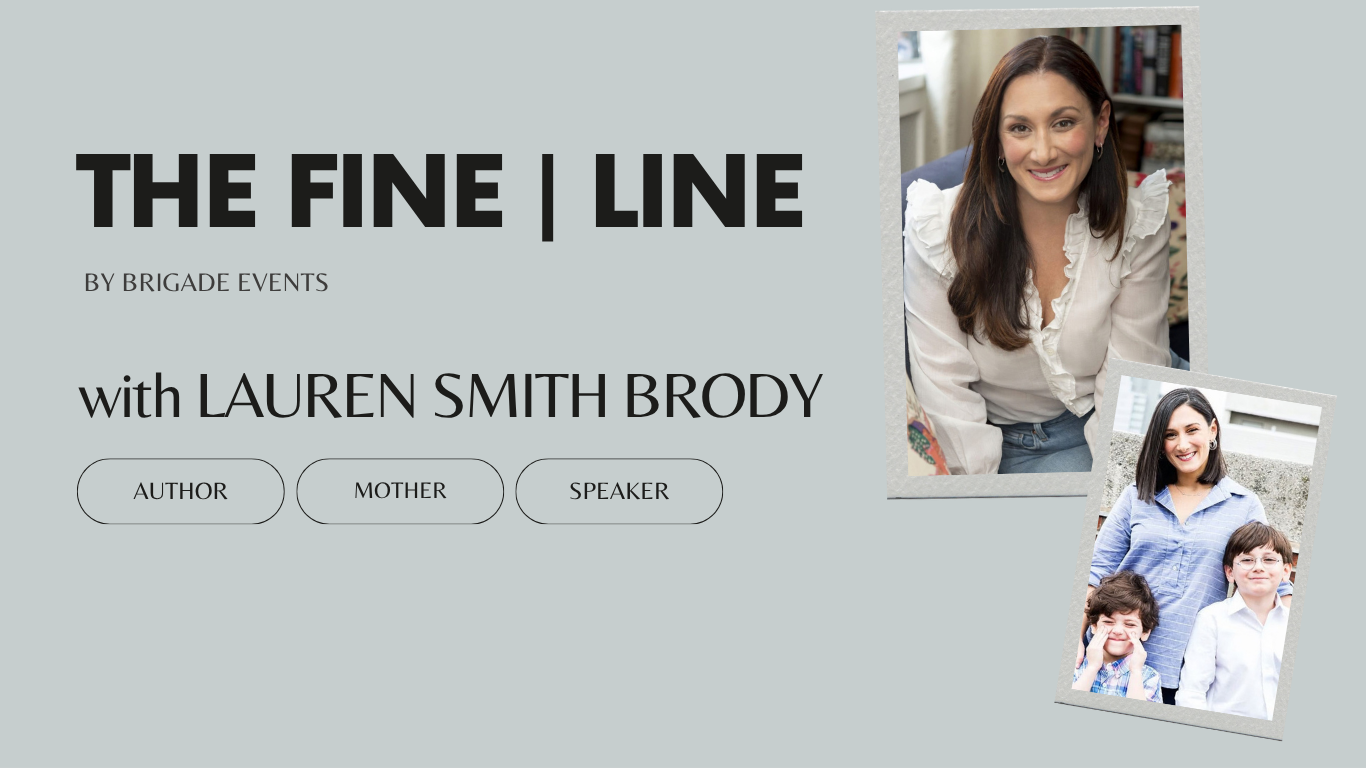
The Fine Line | LAUREN SMITH BRODY
Lauren Smith Brody has spent nearly a decade helping people rethink what it means to build a career alongside a full life.
The author of The Fifth Trimester, Lauren began this work after her own experience returning to work as a new mother. 115 long-form interviews with women helped her see that so many of the struggles she had experienced weren't individual problems at all — they were systemic ones.
Today, her work has expanded far beyond new motherhood. Through research, speaking, coaching, and consulting, Lauren helps companies better support caregivers across every stage of life. She also co-founded Chamber of Mothers, a nonpartisan nonprofit advocating for policies including paid family and medical leave, affordable and accessible child care, and improved maternal health outcomes.
For this edition of The Fine Line, Lauren challenges some of the assumptions we've inherited about what a successful life is supposed to look like: that ambition belongs primarily to our careers, that balance should be achievable every day, and that a business only counts as growing if it keeps getting bigger. Instead, she makes the case for definitions expansive enough to account for all the things we want our lives to hold.
How has motherhood changed the way you think about ambition — and the guilt that so often comes with it?
I have a whole five-minute soliloquy on guilt and how I think it’s a sexist social construct. At the same time, I don’t want to minimize the fact that we feel it.
What helps mitigate it, I think, is expanding what we count as ambition. We’ve been trained from the time we were in first grade to think of ambition as grades and numbers and, eventually, paid work. We think about it largely in terms of career. But if I asked you what your ambitions in life are, career might be a big part of that, but so is everything else that matters to you.
The same is true of guilt. When I was researching The Fifth Trimester, almost every mother I interviewed talked about feeling guilty, but they were describing completely different things. So I started thinking of guilt like a math problem: if guilt is the common denominator, cross it out and solve for the numerator. What is actually driving that feeling?
Maybe you want more time with your children, or your partner, or yourself. Once you name the actual thing, you have something you can work with instead of simply blaming yourself. Guilt implies wrongdoing; most of the time, there is no wrongdoing. There are just people trying to do their best.
You’ve talked about a moment in your career when, in trying to protect the people who worked for you, you ended up taking more and more on yourself. How have you learned to recognize when making it work for everyone else is no longer working for you?
There was a moment when I was at Glamour, working on Women of the Year, when I had been working incredibly hard. I was so aware of the personal lives of the people who worked for me that I was doing a lot to protect them — but that meant I was taking more on myself and stealing more time from my own family.
My husband was in his medical residency at the time, working overnights, so he didn't have time to spare either. Finally, he said something that made me realize I couldn't keep going the way I was.
That moment has stayed with me. I think we're often very good at extending grace to other people while forgetting to include ourselves in the equation. You can keep making something work for a surprisingly long time, but that doesn't necessarily mean it's working.
That's part of why I think about life in seasons now. There are going to be stretches when one part of your life requires more of you than another.
You’ve said you don’t particularly like the idea of “balance.” What feels more realistic to you?
You’re never going to feel like things are perfectly balanced on a daily basis, or even a weekly basis, or sometimes even a monthly basis.
I’ve learned to look at life in roughly three-month chunks. There may be a month when 75 percent of my energy goes toward unpaid work — my family, caregiving, everything happening at home — and 25 percent toward paid work. There may be another stretch where it leans heavily in the opposite direction.
But when I get to the end of three months, it should start to settle out. I should feel like I’ve reached some kind of equilibrium. If it doesn’t, that tells me something. It’s information I can use to recalibrate; it doesn’t mean I’ve done something wrong.
If you try to judge balance on an hourly, daily, or even weekly basis, you’re almost always going to feel like you’re failing.
FOLLOW ALONG
Follow Lauren on her Instagram, join your local chapter of Chamber of Mothers, and read more about The Fifth Trimester here.
Follow Brigade Events and stay tuned for the next iteration of The Fine Line at @brigadeevents.
We’d be honored to include you — or a woman you admire — in this series. If you or someone you know has a story to share, we’d love to hear from you. Reach out to us at carly@ingoodcompanypr.com. Together, we can uplift, support, and redefine leadership for the next generation.
#TheFineLine #WomenWhoLead #BrigadeEvents